Recruiting boards are built out of offers, visits and coaches. This summer a fourth column showed up on Ohio State’s, and nobody on the staff put it there.
What actually happened, in order
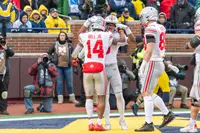
On July 16, per Eleven Warriors’ Dan Hope, Nike named eight college football players as new additions to its NIL roster. One was Ohio State freshman receiver Chris Henry Jr., the No. 14 overall prospect in the 2026 class, who had previously been an Adidas athlete. He joined sophomore running back Bo Jackson and senior cornerback Jermaine Mathews Jr., both of whom signed with Nike earlier in the offseason. That part is a roster story.
The recruiting story is the second half of the same announcement. Nike also signed 11 high school players that day. Eleven Warriors named three of them as Ohio State targets: five-star 2028 cornerback Jermaine Cobbins, five-star 2028 receiver Madoxx Davis, and five-star 2027 cornerback Gabriel Osborne Jr., who committed to Oklahoma in June and whom the Buckeyes were still pursuing.
Not one of them was an Ohio State commit.
The sentence that makes it a story
The week before that announcement, 97.1 The Fan’s Jeremy Birmingham reported, as relayed by Eleven Warriors, that Adidas had “sweetened the pot” in Tennessee’s NIL offer to five-star running back David Gabriel Georges, and that Nike had told Ohio State it does not get involved with high school athletes.
Six days after the announcement, Georges committed to Tennessee over Ohio State.
Read the causation carefully, because this site will not claim more than it read. Georges was not one of the 11. Neither outlet reported that Nike’s high school deals moved him, and neither reported what any of these contracts are worth. What is on the record is narrower and still significant: a policy Ohio State was told about in one week did not hold in the next, and the change became public during the final week of the biggest recruitment on the 2027 board. Logan Hittle, Ohio State’s senior associate athletic director for NIL, posted “All good over here” the same afternoon.
Three weeks later, it landed on a commit
On August 5, per Eleven Warriors’ Lyle Alenstein, New Balance announced an NIL partnership with Jett Harrison, Ohio State’s five-star 2028 receiver commit out of St. Joseph’s Preparatory School in Philadelphia. Harrison caught 51 passes for 811 yards and 10 touchdowns as a sophomore in 2025 and is the No. 4 overall prospect, No. 2 receiver and No. 1 player in Pennsylvania in the 247Sports Composite. He is the highest ranked player in the Buckeyes’ 2028 class, ahead of five-star defensive lineman Jameer Whyce and four-star running back Elijah Newman-Hall.
There is an obvious reason it was New Balance and not one of the other two. His older brother Marvin Harrison Jr., now in his third NFL season with the Arizona Cardinals, is a New Balance athlete, and their father is a Pro Football Hall of Fame receiver. This is the least surprising apparel signing in the country.
It is still the fact that matters. Ohio State got its sixth straight class with a five-star receiver on July 1, and 35 days later that recruit was a national apparel company’s athlete, two and a half years before he can sign a letter of intent.
Ohio’s door was opened by a Buckeye commit
Harrison can do this because he plays in Pennsylvania. In Ohio, that right is fourteen months old, and the name on the case belongs to a player already on this board.
Jamier Brown, Ohio State’s five-star 2027 receiver commit, was at the front of a lawsuit against the Ohio High School Athletic Association during his junior year at Wayne. Per the Dayton Daily News, that suit led to the approval of a name, image and likeness policy in Ohio, and per WHIO-TV the OHSAA permanently approved NIL compensation for high school athletes in November 2025. Both of those citations are laid out in this site’s report on Brown’s two game suspension, which is a separate matter that the Dayton Daily News states plainly is unrelated to the lawsuit.
So the two strands are not the same strand. An Ohio State commit went to court and changed what Ohio allows. A different Ohio State commit, in a different state, signed with a shoe company. They arrived at the same place from opposite directions, and the place they arrived is a 2027 board where the question “who else is paying him” is now a scouting question.
What this changes about reading a recruitment
Not the rankings, and not the visit calendar. What it changes is the set of things that can move a commitment quietly. For most of the last decade, an apparel company’s interest in a recruit was a college-level fact that arrived after signing day. In one four-week stretch this summer it showed up twice on a board where the oldest player involved is a high school senior.
The practical version, for anyone tracking the 2028 class alongside 2027: when a five-star’s recruitment turns and no visit or coaching change explains it, the explanation may be a contract nobody is required to disclose. This site will report those deals when an outlet reports them, with the outlet named, and will not speculate about terms nobody has published.
Four Ohio State players have a reported apparel deal as of today: Henry, Jackson and Mathews with Nike, all three now on the roster, and Harrison with New Balance, still two classes away from campus. That is what has been reported. It is almost certainly not all of what exists.